Shaking is nature’s oldest well-being practice, and science is now starting to catch up. Here is the honest state of the evidence for TRE® and neurogenic shaking: what has been studied, what it suggests, and what we still don’t know. For a plain-English summary, read Does TRE actually work?
In short: most TRE® research is early-stage (pilot studies, case reports and small trials; a 2026 scoping review mapped 22 studies). Results for stress, anxiety, mood, sleep and quality of life are encouraging, but larger controlled trials are still needed. TRE® is not a medical treatment.
The premise
TRE® starts from a simple observation: stress is not only something we think, it is something the body holds. The tremors it invites are usually described as gentle and pleasant, and many people say they feel calmer and more settled afterwards. The method is now taught in many countries by certified providers.
The nervous-system story
Polyvagal theory describes how the autonomic nervous system moves between states of threat and safety. TRE® draws on the body’s natural tremor response: activating it in a safe, controlled setting is proposed to encourage the nervous system back toward regulation. This is a working model rather than settled science. Read more about nervous system regulation.
The history
TRE® is developed by Dr David Berceli, PhD, an international expert in trauma intervention and conflict resolution, who has lived and worked in war-affected regions and natural disaster zones around the world. His 2009 doctoral research at Arizona State University was an early pilot evaluation of the exercises. Today the method, its training and certification are stewarded by TRE for All, Inc., a not-for-profit organisation. Visit TRE for All.
Reviews and overviews
Studies that look across the TRE® research as a whole.
2026, Occupational Therapy in Health Care
Roos, van Niekerk & Tönsing: a scoping review that mapped 22 studies of TRE®. It found promising early signals for stress, anxiety, mood and sleep, and highlighted that most studies are small and vary in quality. Read
2021, Saybrook University
Nordstroem: a literature synthesis on neurogenic tremor and its proposed role in stress recovery. Read
Controlled trials
Studies that compare TRE® with a control group: the strongest kind of evidence so far, though still few and small.
2025, Advances in Mind-Body Medicine
Skovgaard, Trénel, Hanehøj & Lynning: a randomised controlled trial of an eight-week TRE® programme for 28 people with multiple sclerosis. Some outcomes were encouraging, but the main outcome did not differ significantly between groups. Read
2018, Journal of the American Board of Family Medicine
Harrison et al.: a randomised controlled trial of novel exercises for people with restless legs syndrome. Read
2018, Final report and ISTSS poster
Kent; Davis et al.: a controlled clinical trial of neurogenic tremor training (TRE®) for stress and post-traumatic stress symptoms. Read the report
Pilot and exploratory studies
Smaller studies that test whether TRE® is practical and acceptable, and look for early signs of benefit.
2014, Global Advances in Health and Medicine
Berceli, Salmon, Bonifas & Ndefo: a ten-week pilot with non-professional caregivers that reported improvements in health-related quality of life. Small and uncontrolled, but the first published signal. Read
2021, Journal of Traditional and Complementary Medicine
Lynning et al.: a nine-week exploratory pilot with nine people with multiple sclerosis. Improvements from baseline in eight of nine self-reported symptoms, plus stress and sleep quality; objectively measured spasticity did not change. Read
2021, Asia-Pacific Journal of Convergent Research Interchange
Oh & Shin: a pilot study of TRE® and anxiety reduction. Read
2021, Research paper
Torres de Almeida & Oberto Rodrigues: TRE®, heart rate variability and stress in university students. Read
2024, Psychology
Parker, Shook, Washington, English & Tatum: the effect of TRE® on trauma symptoms in East African refugees. Read
2025, Journal of Yoga and Physiotherapy
Fiol, Marrodan et al.: the safety and effects of TRE® as a complementary approach for people with multiple sclerosis. Read
2025, Pilot study
Nadulska: TRE® as a resource for parents, piloted in a primary school setting. Read
Case studies and evaluations
Real-world reports from individuals, groups and community programmes.
2019, Journal of Military and Veterans’ Health
Heath & Beattie: a case report of a former soldier using TRE® for post-traumatic stress self-care. Read
2021, TRE Global
Beattie & Berceli: a global case study of TRE®, perceived stress, flourishing and chronic pain self-efficacy. Findings at a glance
2021, Unpublished paper
Hruby & Beattie: TRE® and depression, anxiety and stress in first responders. Read
2020, Danish Arthritis Association
Rosenberg: an external evaluation of TRE® workshops for people with arthritis, with around 40 participants continuing practice for three months. Read
2013, SWBZA Inc., Australia
Heath: an evaluation of a one-day TRE® workshop for communities affected by the 2013 bushfires, with 39 evaluation participants. Read
Still in progress
Studies planned or under way.
2024, Study protocol
Zhao et al.: a planned randomised controlled trial adding a mother-and-child neurogenic tremor intervention to treatment for adolescent emotional disorders. No results yet. Read
Who has been studied
TRE® has been explored with a wide range of people, including in theses, conference papers and evaluations.
The research so far is promising but early. It suggests TRE® is a practice many people find calming and acceptable, and it is being taken seriously by researchers in many countries. It does not yet prove that TRE® treats any condition.
If you are curious, the best way to find out is to try it gently, with good guidance, and notice how you respond. Read Is TRE safe? before you start.
Summaries above are our own, based on the TRE for All research directory and the published papers. Where a summary describes a study’s aim rather than its result, the original paper has the details.
Disclaimer
TRE® is a well-being practice, not a medical treatment. It is not intended to diagnose, treat or cure any condition, and it does not replace advice from your GP or another qualified health professional. Everyone responds differently, and no particular result can be promised.
Free PDF
The free guide
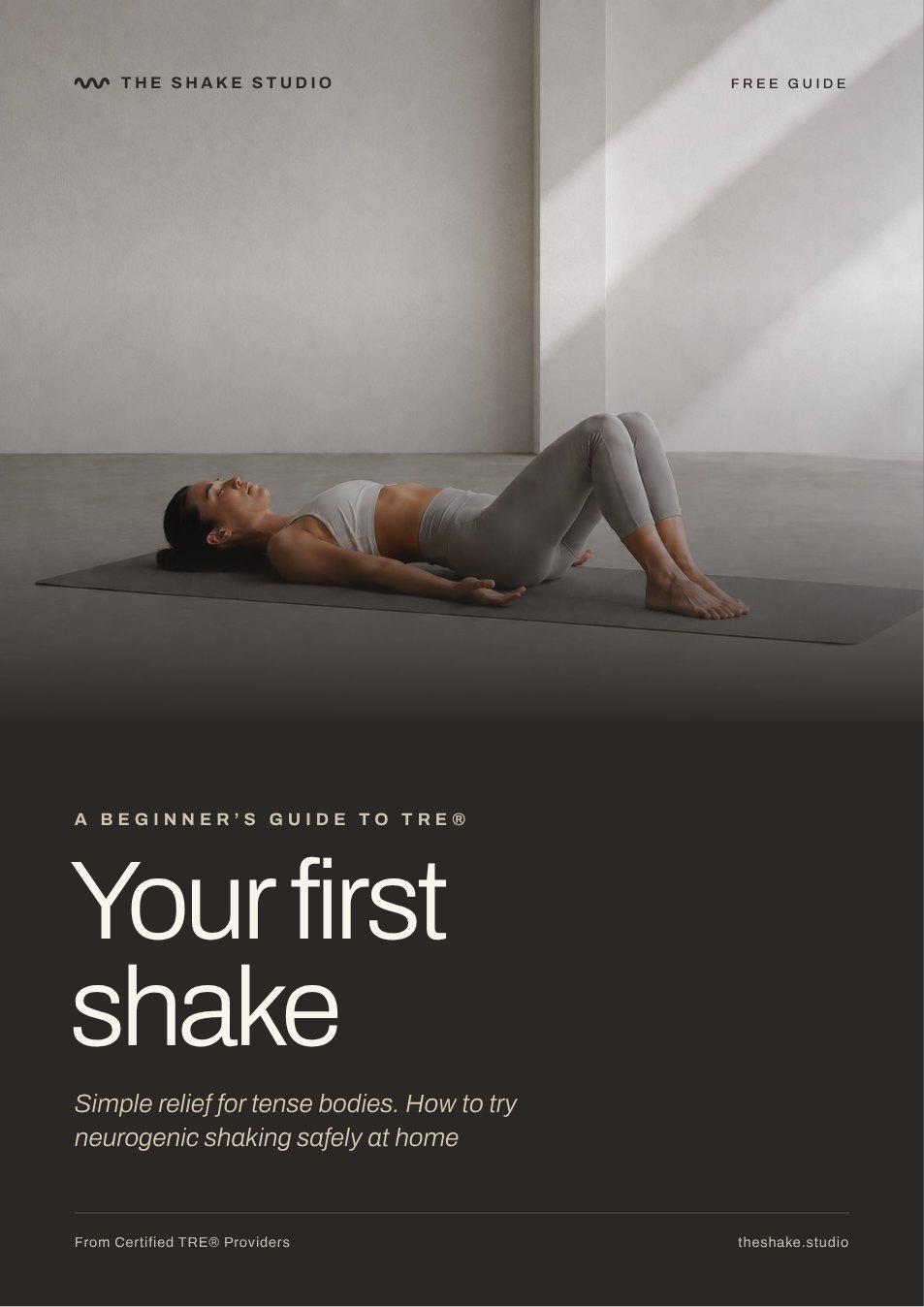
Your first shake.A free guide to trying TRE.
Simple relief for tense bodies. A short PDF guide to trying neurogenic shaking safely at home for the first time.
What TRE shaking is, and why your body does it
How to set up a calm, safe space
A gentle first practice, step by step
How to pause, slow down or stop at any time
We’d like to use Google Analytics cookies to see how people use this site. Privacy policy