Does TRE Actually Work? What the Research Says
Does TRE actually work? Explore the scientific research into Tension and Trauma Releasing Exercises, potential benefits, limitations and what we still need to understand.

Tension and Trauma Releasing Exercises, commonly known as TRE®, is attracting interest from people looking for a different approach to physical tension, stress and wellbeing.
The idea is intriguing.
A sequence of physical exercises encourages a natural tremoring response, which participants learn to allow and regulate.
Some people describe feeling more relaxed afterwards. Others report changes in their physical awareness, mood or experience of stress.
But what does the science actually say?
Does TRE work, or is it another wellness trend with more interesting marketing than evidence?
Let's look at what researchers have discovered so far.
First, what is TRE?
TRE was developed by Dr David Berceli.
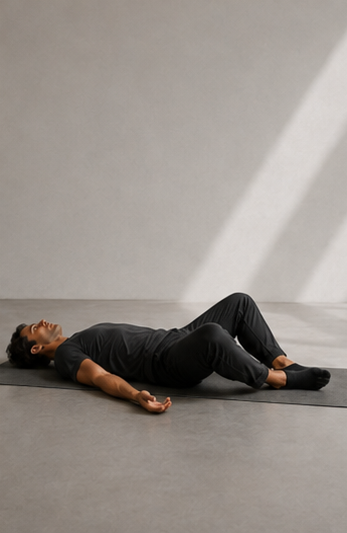
It consists of seven preparatory exercises designed to encourage a self-induced tremoring response.
The exercises involve different muscle groups, particularly around the legs, hips and pelvis.
Following the movements, participants may experience gentle, involuntary tremoring.
The technique is designed to be self-regulated. Participants learn how to begin, pause and stop the process.
Unlike conventional exercise, the objective isn't to build strength, improve cardiovascular fitness or achieve a particular physical performance.
It is a body-based practice that explores the relationship between movement, physical sensations and wellbeing. For a fuller introduction, read What is TRE?.
What does the scientific research show?
Research into TRE is growing, although the evidence base remains relatively small.
One particularly useful publication is a 2026 scoping review by Roos, van Niekerk and Tönsing, published in Occupational Therapy in Health Care.
The researchers examined 22 studies investigating TRE.
The review identified promising findings in several areas, including:
- Stress-related outcomes.
- Anxiety and mood.
- Sleep-related difficulties.
- Cognitive functioning.
- Aspects of general wellbeing.
However, the researchers also identified limitations in the existing literature.
Studies varied in their design, sample sizes and methodological quality.
A scoping review is designed to map the available research. It does not establish that an intervention is definitively effective.
The findings are therefore encouraging, but they should be interpreted cautiously.
What about randomised controlled trials?
Randomised controlled trials are particularly valuable because they allow researchers to compare an intervention against a control condition.
A 2025 randomised controlled trial by Skovgaard and colleagues investigated an eight-week TRE programme involving 28 people with multiple sclerosis.
The study explored whether TRE might have an effect on fatigue and other outcomes in this population.
Some encouraging findings emerged, but the primary outcome was not significantly different between groups in the unadjusted analysis.
The study is useful because it provides an example of TRE being investigated through a more rigorous research design.
However, it was a relatively small study involving a specific clinical population.
Its findings cannot automatically be generalised to everyone who practises TRE.
Why do people report feeling different after TRE?
There are several possible explanations worth exploring.
Physical movement can influence how we experience our bodies.
Learning to pay attention to physical sensations may also change how we recognise tension, comfort and relaxation.
The tremoring response itself is another area of scientific interest. You can read more in Why does your body shake?
However, the exact physiological mechanisms proposed by TRE practitioners are not fully established.
We should be careful about claiming that shaking physically removes stored trauma, releases specific chemicals or resets the nervous system.
These are stronger claims than the available research currently supports.
It is entirely possible to value someone's personal experience without presenting that experience as scientific proof.
Does TRE release trauma?
This is an important distinction.
The name Tension and Trauma Releasing Exercises can give the impression that TRE is a clinically established trauma treatment.
It isn't.
Trauma involves complex psychological, neurological, physiological and social processes.
Although body-based approaches are being investigated in trauma-related research, this does not establish that TRE releases traumatic memories or cures post-traumatic stress disorder.
For adults with PTSD, NICE recommends evidence-based treatments including trauma-focused cognitive behavioural therapy and, where appropriate, EMDR.
TRE should not be marketed as a replacement for these treatments.
So, is TRE worth exploring?
That depends on what you're looking for.
If you are curious about movement, body awareness and alternative approaches to everyday wellbeing, TRE may be worth learning about.
It offers a different physical experience from conventional exercise, meditation or stretching.
However, it is important to approach the practice with realistic expectations.
It isn't a guaranteed solution to anxiety, trauma, chronic stress or physical pain.
Individual responses vary, and the evidence is still developing. Before you start, read Is TRE safe?
What we believe at The Shake Studio
We believe people deserve access to different ways of exploring wellbeing.
Not every useful practice has to involve sitting still, following a meditation or pushing through another fitness routine.
TRE offers an interesting approach to movement and physical awareness.
We are interested in making that approach accessible while being honest about what is known, what is still being researched and what should not be promised.
For us, credibility matters more than exaggerated claims.
Research and further reading
- Roos, L.A.J., van Niekerk, K. & Tönsing, K.M. (2026). Trauma Releasing Exercises as a Treatment Technique: A Scoping Review. Occupational Therapy in Health Care. Read the review.
- Skovgaard, L. et al. (2025). Tension and Trauma Releasing Exercises for People with Multiple Sclerosis: A Randomized Controlled Trial. Read the study on PubMed.
- NICE. Post-traumatic stress disorder: recommendations.
This article is educational and does not replace medical or psychological advice. TRE is a well-being practice, not a treatment.