What Are Somatic Exercises? A Beginner's Guide to Body-Based Movement
What are somatic exercises and how do they work? Discover body-based movement, physical awareness and the different approaches to somatic wellbeing.

Most of us are familiar with exercise.
We run, lift weights, stretch, cycle, swim and take part in activities designed to improve strength, fitness or flexibility.
But there is another way of thinking about movement.
Somatic exercises focus on the experience of movement from within the body.
Rather than concentrating exclusively on how an exercise looks or how much effort it requires, somatic practices encourage you to notice physical sensations, movement patterns and how your body responds.
It is an interesting approach for anyone curious about the relationship between physical experience and wellbeing.
What does somatic mean?
The word somatic comes from the Greek word soma, meaning body.
In wellbeing, somatic approaches generally place emphasis on the lived experience of the body.
This might involve noticing:
- Where you feel tension.
- How your breathing changes.
- How your body responds to movement.
- Which positions feel comfortable.
- How physical sensations change over time.
Somatic practices can take many forms.
There is no single universally agreed definition covering every exercise described as somatic.
How are somatic exercises different from conventional exercise?
Traditional exercise often has an external goal.
You might want to lift a particular weight, run a certain distance or improve your flexibility.
Somatic exercises generally place greater emphasis on internal awareness and the quality of movement.
For example, instead of trying to stretch as far as possible, you might move gently and pay attention to how the movement feels.
Instead of completing a workout as quickly as possible, you might slow down and explore the sensations involved.
Neither approach is inherently better.
They serve different purposes and can complement each other.
Five examples of somatic exercises
1. Body scanning
Sit or lie comfortably.
Move your attention gradually through your body.
Notice sensations in your feet, legs, abdomen, shoulders and face.
You don't need to change anything. Simply notice what is happening.
2. Gentle pelvic movement
Lie on your back with your knees bent and feet supported.
Gently tilt your pelvis forwards and backwards through a small, comfortable range.
Notice how your lower back responds.
Avoid forcing the movement.
3. Shoulder awareness
Raise your shoulders slightly, then allow them to settle.
Notice the difference between the two positions.
Repeat slowly, paying attention to how the movement feels.
4. Mindful walking
Walk at a comfortable pace.
Notice the movement of your legs, the contact of your feet with the ground and the environment around you.
Allow your attention to move between these sensations.
5. TRE
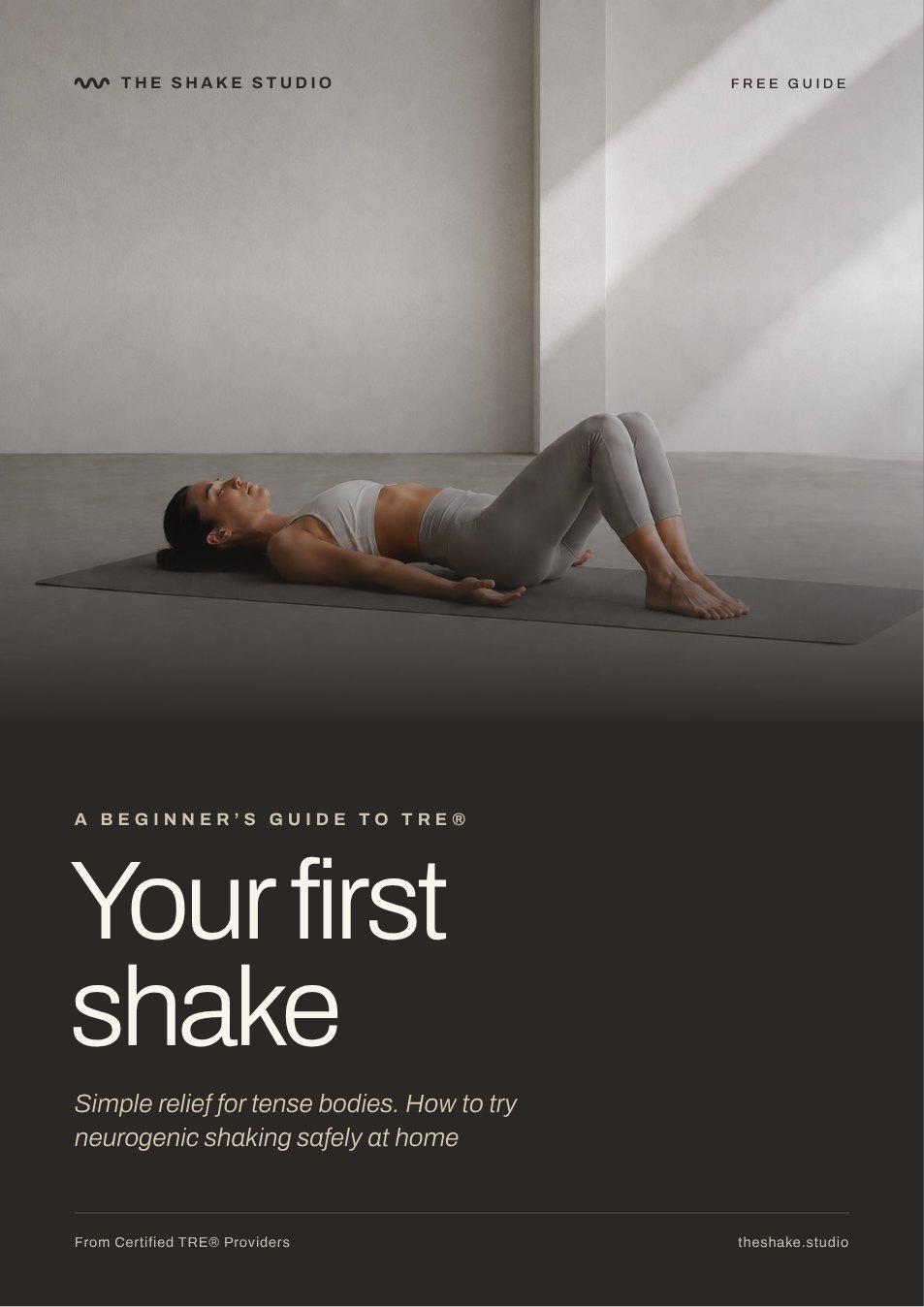
Tension and Trauma Releasing Exercises is a particular body-based practice involving seven preparatory exercises designed to encourage self-induced tremoring.
Unlike conventional stretching, TRE involves learning to allow and regulate a tremoring response.
It is one example of a movement-based approach that places attention on physical experience.
What are the potential benefits?
Somatic practices are often explored for:
- Greater awareness of physical sensations.
- Recognising habitual muscular tension.
- Developing more comfortable movement patterns.
- Supporting relaxation.
- Creating opportunities for mindful movement.
However, it is important not to assume that all somatic exercises have the same evidence base.
Research into mindfulness, yoga, progressive muscle relaxation and TRE covers different techniques and outcomes.
For example, a 2024 systematic review of yoga and meditation components found that many of the included studies reported reduced acute stress reactivity following a single session.
That evidence cannot automatically be applied to every practice described as somatic.
Are somatic exercises good for anxiety?
Some people find body-based practices useful as part of their wider approach to managing stress and anxiety.
They can provide a practical focus outside of repetitive thoughts and worries.
The World Health Organization's stress management guide includes grounding, awareness and other practical skills for coping with stress.
However, body-focused exercises do not suit everyone.
For some people, paying close attention to internal sensations can increase discomfort or anxiety.
It is perfectly reasonable to keep your attention on your surroundings or choose a different practice.
If anxiety is significantly affecting your life, professional support may be appropriate.
Are somatic exercises the same as TRE?
No.
Somatic exercise is a broad description, whereas TRE is a specific technique.
TRE has its own sequence of seven exercises and a particular focus on encouraging a self-induced tremoring response.
Other somatic practices may focus on awareness, gentle movement, breathing or relaxation without involving tremoring.
It is useful to understand this distinction rather than treating all body-based practices as interchangeable. The same is true of Somatic Experiencing: see TRE vs Somatic Experiencing.
Finding a different relationship with movement
We often judge exercise by what it achieves.
How many calories did we burn? How much weight did we lift? How far did we run?
Somatic practices invite another question.
What did you notice?
At The Shake Studio, we're interested in exploring this different relationship with movement.
TRE is one way of doing that.
We want to make it easier for people to discover body-based wellbeing without unnecessary jargon, unrealistic promises or pressure to perform.
Research and further reading
- World Health Organization (2020). Doing What Matters in Times of Stress.
- Mandlik, G.V. et al. (2024). Effect of a single session of yoga and meditation on stress reactivity: A systematic review.
- Roos et al. (2026). TRE scoping review.
- NHS inform. Progressive muscle relaxation.
This article is educational and does not replace medical or psychological advice. TRE is a well-being practice, not a treatment.